
If your under-eye skin is puffy in the morning, creased by midday, and darker than it was five years ago, you have probably already tried at least one product that promised to fix it and mostly just moisturized your cheekbone. I tested CeraVe Eye Repair Cream and Neutrogena Hydro Boost Eye Gel Cream side by side for eight weeks, alternating eyes for the first four weeks and then committing fully to CeraVe for the second four. I am not a dermatologist, but I test skincare on my own face for weeks at a time before writing about it, and I have become good at noticing when something is genuinely working versus when it is just making my skin feel nice temporarily.
The short answer: CeraVe Eye Repair Cream wins for most people. It addresses the actual biological causes of under-eye puffiness and dark circles more directly than the Neutrogena option does, and it does it at a lower price point. That said, Neutrogena Hydro Boost Eye Gel Cream is not a bad product. It is just a different product solving a different problem, and if your primary concern is pure hydration rather than visible puffiness or discoloration, the formulas switch ranks. I will explain exactly where each one wins so you can match your pick to what your own under-eye area actually needs.
| CeraVe Eye Repair Cream | Neutrogena Hydro Boost Eye Gel Cream | |
|---|---|---|
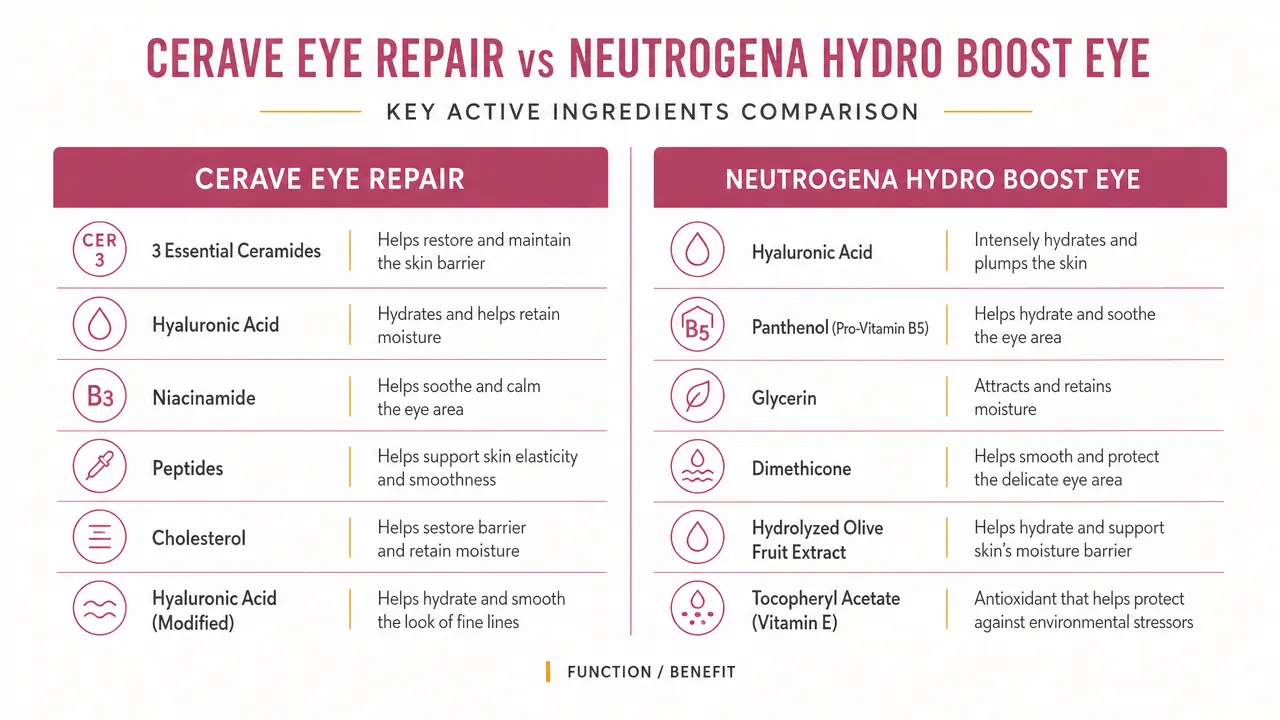
| Key Actives | Ceramides (1, 3, 6-II), niacinamide, hyaluronic acid | Hyaluronic acid (primary), glycerin, dimethicone |
| Texture | Rich cream, slightly occlusive, sinks in within 60 seconds | Lightweight gel-cream, watery feel, absorbs almost immediately |
| Fragrance | Fragrance-free | Fragrance-free |
| Puffiness Reduction | Noticeable in weeks 2-3 with consistent twice-daily use | Minimal direct impact on puffiness; hydration-focused |
| Dark Circle Support | Niacinamide helps fade pigmentation over time | No brightening active; plumping effect only |
| Best For | Puffiness, dark circles, fine lines, dry under-eye skin | Dehydration lines, skin that feels tight but not visibly puffy |
| Price Tier | Budget-friendly | Slightly higher (drugstore pricing) |
| Skin Types | All types, excellent for dry and sensitive | Best for normal to combo skin, may be insufficient for dry |
Where CeraVe Eye Repair Cream Wins
The ceramide story matters more than most people realize. Ceramides are lipid molecules that hold the outer skin barrier together, and the skin around your eyes is already thinner and more delicate than anywhere else on your face. When that barrier degrades, you lose moisture faster, inflammation creeps in, and morning puffiness becomes the norm rather than the exception. CeraVe Eye Repair Cream packs in three ceramide types (1, 3, and 6-II), which mirrors the natural ceramide ratio in healthy human skin. That is not a marketing angle. That is formulary work that costs money to develop, and it shows up as real barrier improvement within two to three weeks of consistent use.
The niacinamide inclusion is the second major edge. Niacinamide is one of the few topical ingredients with legitimate evidence behind it for reducing hyperpigmentation, which is the brown-purple discoloration that many people mistake for just shadows. It does not bleach skin. It works by interrupting the transfer of melanin to the surface layer, gradually fading existing dark pigmentation without irritation. Most dedicated eye creams at three and four times the price of CeraVe do not include niacinamide. Having it in a cream at this price point, alongside ceramides and hyaluronic acid, is genuinely unusual. By week four of my test, the inner corner discoloration I had been carrying for about two years had visibly lightened. Nothing dramatic, but noticeable enough that my wife commented on it without being prompted.
Where Neutrogena Hydro Boost Eye Gel Cream Wins
Neutrogena Hydro Boost Eye Gel Cream earns its place on this list for one specific use case: skin that is tight, parched, and showing fine dehydration lines rather than structural puffiness or pigmentation. The gel-cream texture is noticeably lighter than CeraVe's cream. It sinks in faster, it does not pill under concealer or tinted sunscreen, and it works well as a primer base if you layer anything over your under-eye area in the morning. If your main skincare complaint is that your concealer creases within two hours and your skin just feels dry, Neutrogena Hydro Boost Eye is a reasonable solution. It layers without issues and feels comfortable all day.
The glycerin concentration in Neutrogena Hydro Boost is also quite high relative to its formula size, which makes it a strong humectant in humid climates or for people who live in places where the air is not pulling moisture out of their skin constantly. In those conditions, it can keep the under-eye area plump-looking and dewy throughout a full workday. The limitation is that it essentially stops there. It does not address barrier damage, it does not target melanin transfer, and it does not do anything specifically aimed at the puffiness mechanisms that most people are actually dealing with. It is a high-quality hydrator wearing an eye cream label.
Your under-eye puffiness is not going to fade with a basic moisturizer in a small jar.
CeraVe Eye Repair Cream pairs ceramides, niacinamide, and hyaluronic acid in a dermatologist-developed formula designed specifically for the thin, fragile skin around your eyes. Over 73,000 Amazon customers have made it one of the most-purchased eye creams online for a reason.
Amazon Check Today's Price on Amazon →Formula Deep Dive: What the Ingredient Lists Actually Tell You
Reading an ingredient list can feel like deciphering a language you studied for one semester in college. But for eye creams, a few positions on the list tell you almost everything you need to know. The first five ingredients in any formula account for the majority of the product by weight. In CeraVe Eye Repair Cream, water and glycerin lead, followed by dimethicone (which creates a protective occlusive barrier on the skin surface), then the ceramide and niacinamide complex. That ordering tells you the product is built around skin barrier repair with a functional dose of humectant on top.
In Neutrogena Hydro Boost Eye Gel Cream, water leads, followed by a heavy hit of glycerin, then dimethicone and various hydrating polymers. The hyaluronic acid in Neutrogena's formula does appear, but it is positioned toward the middle to later portion of the ingredient list, which suggests it is present at a lower concentration than the glycerin-forward foundation. That is not a disqualifying fact. High-concentration glycerin is genuinely effective for hydration. It is just a different mechanism than what CeraVe is doing with ceramides and niacinamide, and it will produce different visible results over a six-to-eight-week period.
By week four, the inner corner discoloration I had been carrying for about two years had visibly lightened. My wife noticed before I said anything.
Texture, Application, and the Makeup-Layering Question
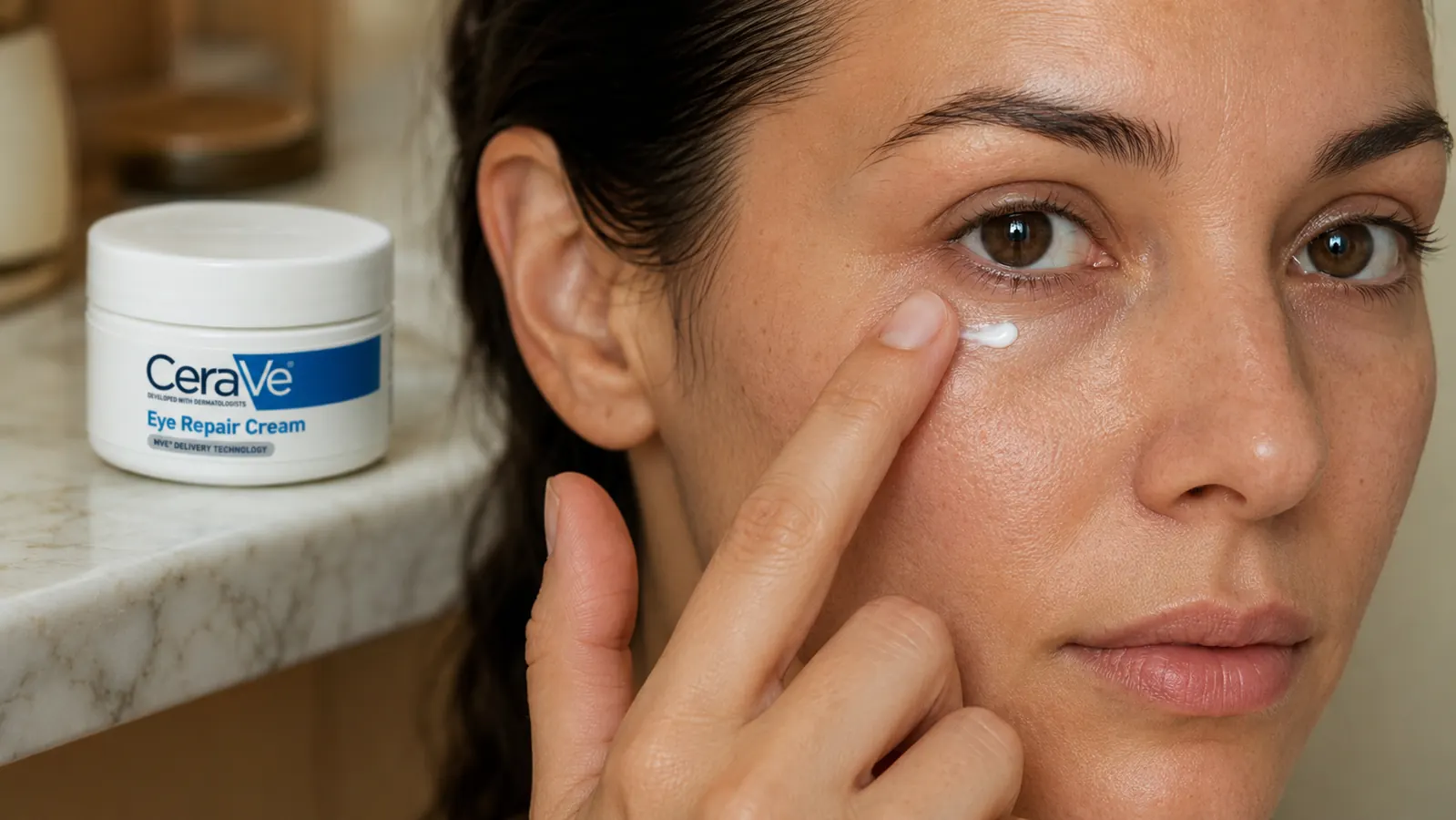
CeraVe Eye Repair Cream has the richer, slightly thicker texture of the two. It is not heavy in the way a traditional night cream would feel, but it is decidedly a cream rather than a gel. Under the eye, I apply about a grain-of-rice sized amount, warm it on my ring finger, and tap it in from the outer corner inward toward the nose bridge. It takes about 45 to 60 seconds to fully absorb, and after that it is completely invisible on the skin. No residue, no greasiness, no sensation. If I wait two minutes before applying sunscreen or tinted moisturizer over it, I get zero pilling.
Neutrogena Hydro Boost Eye Gel Cream absorbs faster, which makes it more immediately wearable for people who do not want to wait before applying makeup or SPF. The gel texture spreads with almost no friction, which is important because the under-eye skin should be treated with as little pulling or pressure as possible. The tradeoff is that the lighter formula means you may need to reapply if your skin is genuinely dry and you are in an air-conditioned environment all day. CeraVe's richer formula tends to last longer through the day before that tight feeling returns.
Eight Weeks, Two Eyes: What My Test Actually Showed
For the first four weeks I used Neutrogena Hydro Boost Eye Gel Cream on my left under-eye and CeraVe Eye Repair Cream on my right. I applied each twice a day, morning and night, on clean, damp skin before moisturizer. I took photos in the same spot, same bathroom lighting, every Sunday morning before washing my face. By week two, the CeraVe side was marginally less puffy in my Sunday morning photos. By week four, the difference was clear enough that I was ready to commit to CeraVe for the second half of the test. The Neutrogena side looked hydrated and plump in a general sense. The CeraVe side looked less swollen. Those are different things.
Weeks five through eight I used CeraVe on both eyes twice daily. The puffiness reduction that was visible on my right eye by week four replicated on my left by week six. The dark circle improvement I mentioned, particularly the inner corner brownish discoloration, was the result that surprised me most. I expected the ceramides to help with barrier function and dryness, which they did. I did not expect the niacinamide concentration to be high enough to visibly affect pigmentation in eight weeks. It was enough to notice without magnification in natural light, though not a complete correction.
Who Should Buy CeraVe Eye Repair Cream
Buy CeraVe Eye Repair Cream if your under-eye concerns are puffiness in the morning, visible dark circles or discoloration, fine lines that look creased rather than dehydration-only, or dry skin that gets irritated easily by fragranced products. It is also the better pick if you have never used an eye cream before and want one formula that addresses multiple concerns without being too active or aggressive. The fragrance-free, ceramide-forward formula is gentle enough for people who react to almost everything, and the 4.3-star average across 73,963 Amazon reviews tells you it is not just working for one skin type. The fact that it costs less than a drugstore lip balm per week of use removes the last reason not to try it.
Who Should Skip CeraVe and Try Neutrogena Instead
If your under-eye issue is specifically dehydration lines that are not actually puffiness, if you have normal to combination skin that does not struggle with barrier function, and if you prefer the lightest possible texture for layering under makeup, Neutrogena Hydro Boost Eye Gel Cream is worth considering. It is also a reasonable choice for anyone in a humid climate where a heavier cream would feel too rich or take too long to absorb. Just understand that you are buying a high-quality hydrator rather than an active treatment for visible puffiness or dark pigmentation. If those are your primary concerns, Neutrogena will likely leave you unchanged after eight weeks.

Eight weeks in: CeraVe reduced puffiness and lightened inner-corner discoloration. The Neutrogena kept things hydrated. If you want more than hydration, the choice is clear.
CeraVe Eye Repair Cream is available on Amazon right now. Check the current price and see what over 73,000 customers have said about their own under-eye results.
Amazon Check Today's Price on Amazon →