

I used to think dry skin was just dry skin. You put moisturizer on it. You wait. Nothing changes. I went through this cycle for two winters before I figured out that I was using hyaluronic acid completely wrong, and every time I applied it I was actually making my skin drier by the end of the day. If you are dealing with tight, flaky, or dull skin that does not respond to moisturizer the way you expect, there is a good chance the problem is not your skin type. It is your application technique.
Hyaluronic acid is a humectant. It works by drawing moisture toward itself. Applied to damp skin, it pulls water from the air and from the top layer of your skin and locks it into place. Applied to bone-dry skin in a dry room, it pulls moisture from deeper layers of your own dermis upward and then lets it evaporate. The result is skin that feels even drier a few hours later. Once I understood this, I stopped chasing the fanciest serum and started paying attention to the technique. Now I use Vanicream Daily Facial Moisturizer with ceramides and hyaluronic acid as my anchor step, and my skin has stayed consistently hydrated through an entire dry season without any flaking or tightness. Here is exactly how I do it.
Your moisturizer is not the problem. Your timing probably is.
Vanicream Daily Facial Moisturizer delivers hyaluronic acid and ceramides in a fragrance-free, dye-free base that works with this exact technique. No irritants, no guesswork. With over 24,000 Amazon ratings at 4.6 stars, it is the anchor step this routine is built around.
Amazon Check Today's Price on Amazon →Step 1: Apply on Damp Skin, Not Dry Skin
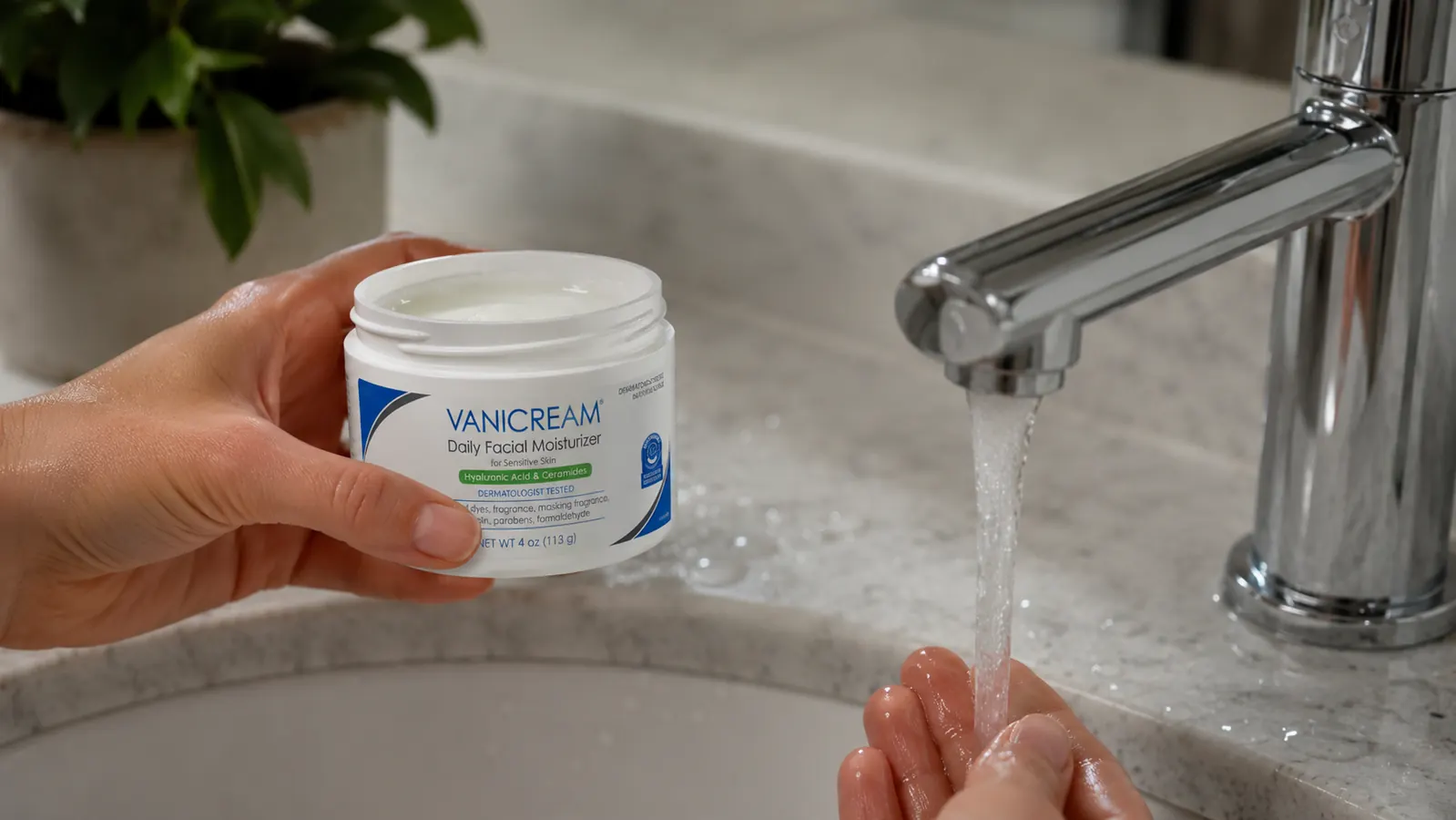
The single most important rule with hyaluronic acid is to apply it while your skin is still damp. Right after you wash your face or rinse your skin with lukewarm water, pat it with a towel twice, then stop. Your skin should still feel slightly dewy, not wet and not completely dry. That surface moisture is what the hyaluronic acid in your moisturizer will bind to and hold in place.
I set a small timer on my phone for 60 seconds after washing. That is all the time I allow myself before I reach for the Vanicream. If you dry your face completely and then try to apply a hyaluronic acid moisturizer, you are going backward. The humectant has no surface water to work with, so it goes looking for it in your skin instead. On low-humidity days, this is especially pronounced. You will feel a brief softness and then a return of tightness within a couple of hours. Change the timing and you will notice a difference within a few days.
This step is free. It costs nothing to change when you reach for your moisturizer. It is also the reason a mid-range fragrance-free moisturizer like Vanicream can outperform something three times the price that gets applied to dry skin at the wrong moment.
Step 2: Use the Right Amount and Layer Order
More moisturizer does not mean more hydration. I use about a nickel-sized amount of the Vanicream for my full face and neck, applied with gentle pressing motions rather than rubbing. Rubbing can disrupt the damp surface film before the hyaluronic acid has a chance to bind to it. Press it in with your fingertips in small sections, starting at the center of your face and moving outward.
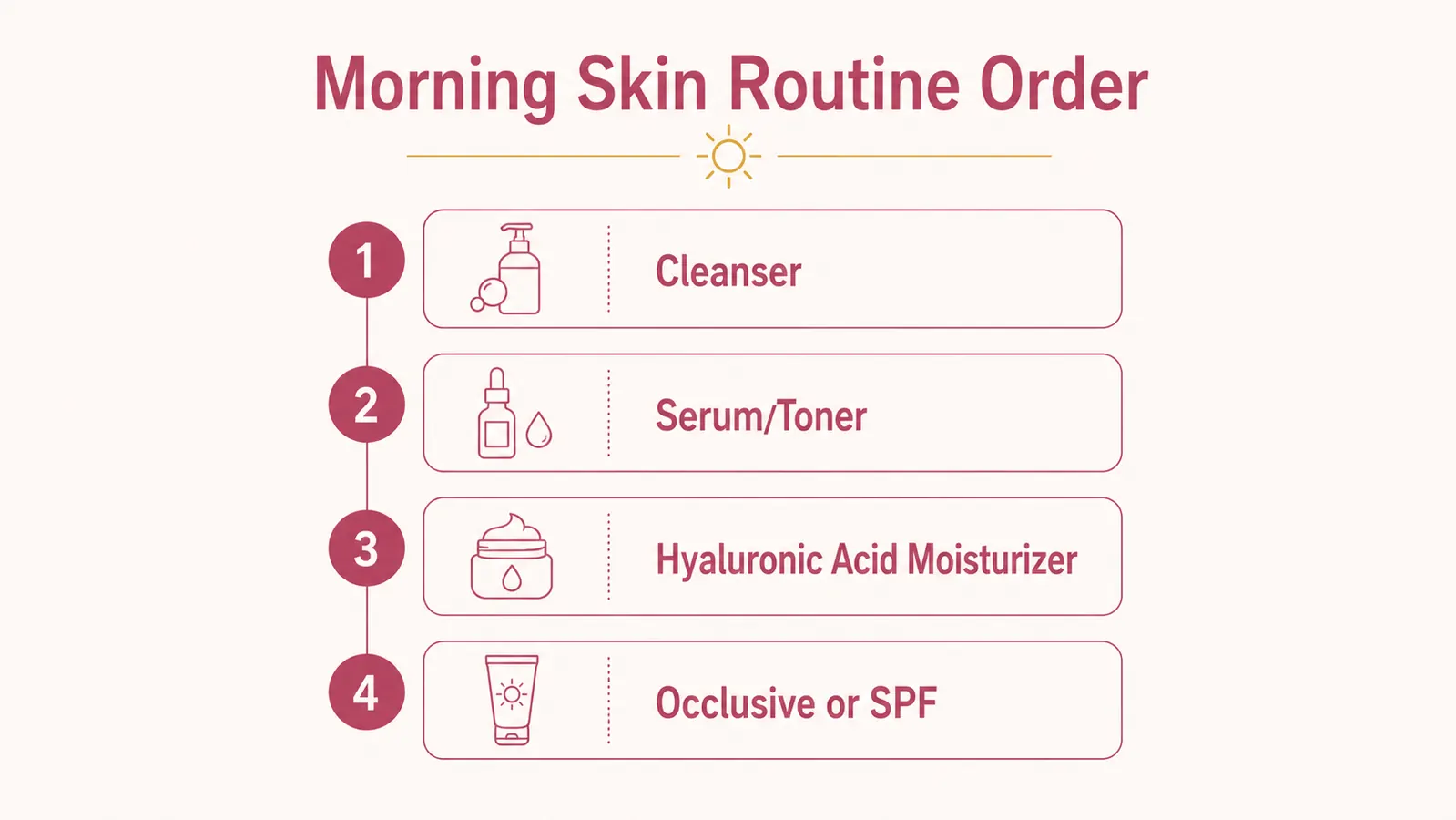
If you are layering additional products, order matters. Thinner, water-based products go first. A toner or an essence goes on right after cleansing while skin is still damp. Then your hyaluronic acid moisturizer goes on top. If you are using a dedicated HA serum underneath, apply it first and allow it to absorb for thirty seconds before adding the moisturizer over it. The moisturizer creates a surface film that slows water loss from the layers beneath it.
What you should not do is apply a thick occlusive balm or petroleum-based product before the Vanicream. Occlusives belong on top, not underneath. If you get this backward, the occlusive blocks the hyaluronic acid from reaching the surface moisture it needs to work with. The diagram above shows the correct layering order I use every morning.
Step 3: Support Your Skin Barrier with Ceramides
Hyaluronic acid draws moisture in. Ceramides keep it from escaping. These two ingredients do different jobs, and a moisturizer that contains both covers both problems at once. The Vanicream Daily Facial Moisturizer includes ceramides specifically for this reason. Ceramides are lipid molecules that make up roughly half of your skin's outer barrier layer. When that barrier is compromised, water escapes faster than any humectant can replace it.
Signs that your skin barrier is compromised include persistent tightness even after moisturizing, stinging when you apply any product, and redness that seems to come from nowhere. If you have any of these, the ceramide component of your moisturizer becomes more important than the hyaluronic acid. For my skin specifically, I noticed these signs appearing every time I got aggressive with a scrub or overused actives. The Vanicream helped calm things down because it does not contain any irritants, dyes, fragrances, or preservatives that would add further stress to an already unhappy barrier.
One practical move I made was using the Vanicream as a double-duty step at night on evenings when my barrier felt stressed. I skip all actives, cleanse gently, and apply a slightly more generous layer while skin is damp. Then I seal it with a thin layer of occlusive on the driest patches, usually around my jawline. By morning, my skin is noticeably calmer. The ceramides in the moisturizer do most of the overnight repair work.
Ceramides keep moisture from escaping. Hyaluronic acid draws it in. You need both. A moisturizer that does only one of those jobs is doing half the work.
Step 4: Avoid Over-Exfoliating Between Uses
This step is about what not to do. Over-exfoliation is one of the most common reasons a hyaluronic acid routine stops working. Chemical exfoliants like AHAs and BHAs, physical scrubs, and even some enzyme masks break down the outer layer of skin. A small amount of this is useful. Too much, and you strip away the barrier that ceramides and hyaluronic acid are trying to maintain.
I used to exfoliate three to four times a week because I thought it would help my moisturizer absorb better. It made my skin more reactive and more dry, not less. When I cut back to once a week maximum, and only used a gentle lactic acid option, my skin started responding to the Vanicream the way it is supposed to. The HA had a working barrier to hydrate instead of a compromised one it was constantly fighting.
A practical rule: if your skin feels tight or sensitive the day after exfoliating, you exfoliated too aggressively or too often. Pull back the frequency before you reach for a stronger moisturizer. The moisturizer is not the problem on those days. Give the barrier time to recover, keep applying the ceramide moisturizer on damp skin, and skip the exfoliant for a week. Most people see a noticeable improvement within five to seven days.
Step 5: Lock It All In with an Occlusive
The final step is optional in humid climates or during summer but becomes essential in dry air, low-humidity environments, or heated indoor spaces in winter. An occlusive is a heavy emollient that forms a physical barrier over the skin surface, slowing transepidermal water loss (TEWL) dramatically. Common occlusives include petroleum jelly, lanolin, shea butter-heavy balms, and squalane oil.
My winter routine ends with a very thin layer of pure petroleum jelly on the driest patches after my Vanicream has been applied. I am talking about a barely-there film, not a thick coating. This layer does not add hydration. It prevents the hydration from leaving. The Vanicream handles the HA and ceramide work. The occlusive just holds the door shut. If you skip this step in a low-humidity environment, you may find that your well-applied moisturizer still does not last through the day.
For people with oily or combination skin who do not want to use petroleum jelly on their face, squalane oil is a lighter alternative that still provides meaningful occlusion without heaviness. Apply it as the final step, one to two drops patted over the cheeks and any dry zones. In a truly heated indoor environment in January, this step alone made the difference between my skin feeling hydrated by noon or feeling tight again by 10 a.m.
What Else Helps
Environment matters more than most skincare guides admit. A bedroom or office with forced-air heat typically runs at 20 to 30 percent relative humidity in winter. Hyaluronic acid needs ambient moisture to pull from. If there is none in the air, all five steps above become harder. A small humidifier set to 45 to 50 percent relative humidity, placed in the room where you sleep, will noticeably improve how long your skin stays hydrated between applications. It is not glamorous, but it is probably more effective than upgrading to a fancier moisturizer.
Water temperature also matters. Hot showers strip sebum and disrupt your barrier faster than almost anything else in a daily routine. Lukewarm water preserves more of the natural oils that your ceramide moisturizer is trying to support. If you shower before applying Vanicream, make the water cooler and keep the shower shorter. You will spend less time trying to repair a barrier that a hot shower just damaged.
Internal hydration is the one factor no topical product can replace. If you are chronically dehydrated, hyaluronic acid will still work, but it has less to pull from and your overall skin turgor will remain low. Consistent water intake, combined with this technique and the right moisturizer, produces noticeably better results than the moisturizer alone. I track how my skin looks in the morning as a rough gauge of whether I drank enough the day before. It is surprisingly reliable.
Finally, if you want to go deeper on why Vanicream's ingredient profile works so well for this routine, check out my full 60-day review at Vanicream Moisturizer Review: 60 Days on Sensitive, Dehydrated Skin. And if you want more detail on what hyaluronic acid moisturizers do at the cellular level, see 10 Reasons a Hyaluronic Acid Moisturizer Can Rescue Dry, Tight Skin.
If your skin is still tight after moisturizing, it is the technique, not the moisturizer. Start here.
Vanicream Daily Facial Moisturizer with ceramides and hyaluronic acid is the product this entire routine is built around. Fragrance-free, dye-free, preservative-free. It does exactly what it is supposed to do when you apply it the right way. Over 24,000 verified Amazon ratings back it up.
Amazon Check Today's Price on Amazon →