
If you have been debating between CeraVe Tinted Mineral Sunscreen SPF 30 and La Roche-Posay Anthelios Tinted Mineral Fluid SPF 50, you have probably already noticed the price gap. It is not subtle. CeraVe sits comfortably in the drugstore range, while La Roche-Posay pushes close to department-store territory. The honest answer most reviewers skip over: that gap matters for some skin types and means almost nothing for others.
I am Tim. I test skincare on my own face before I write a word about it. For this comparison, I wore CeraVe Tinted SPF 30 for three weeks, then switched to La Roche-Posay Anthelios Tinted for another three weeks, keeping everything else in my routine constant. Same cleanser, same moisturizer, same mirror, same lighting when I checked results. Here is what I found.
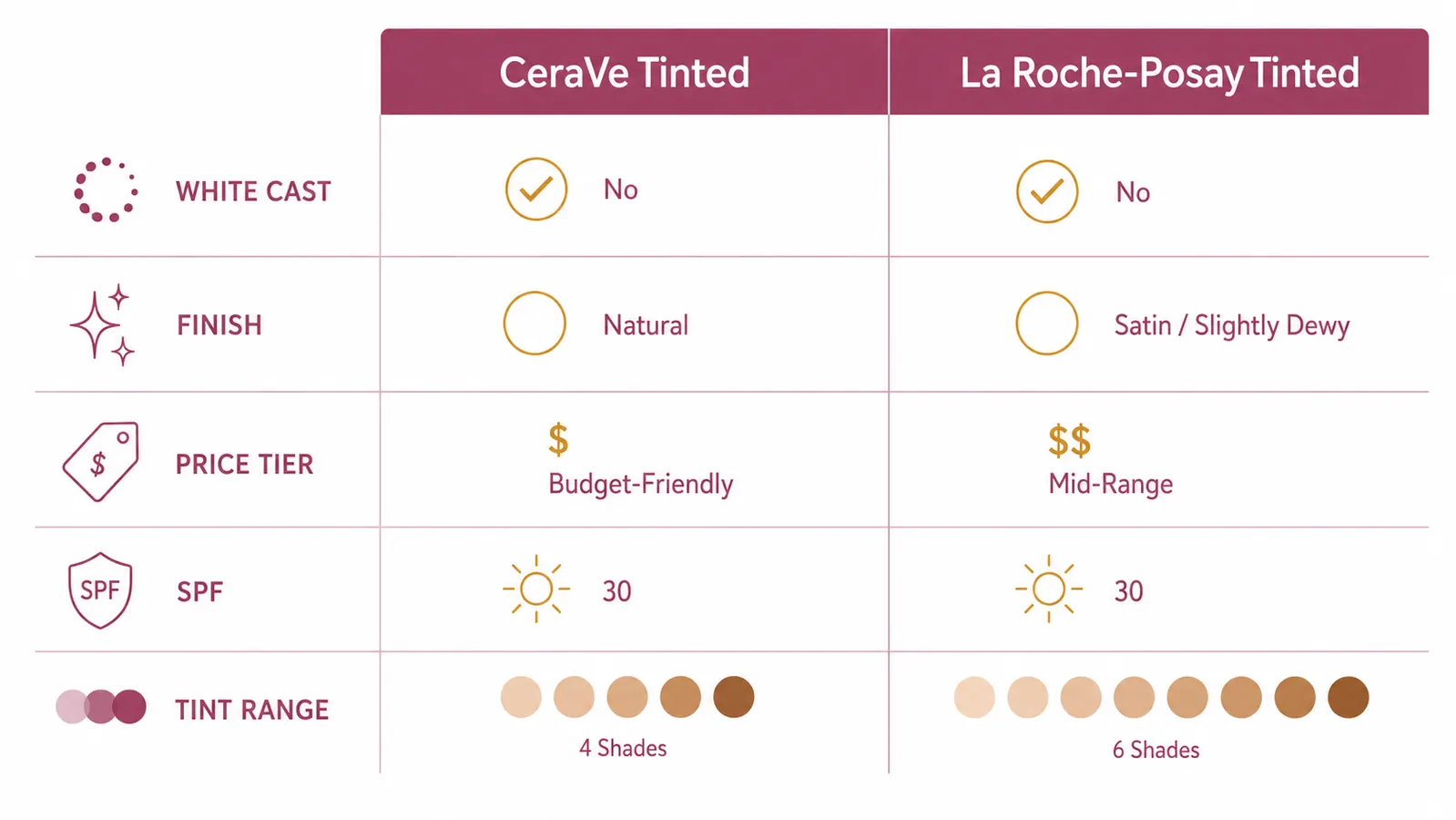
| Feature | CeraVe Tinted Mineral SPF 30 | La Roche-Posay Anthelios Tinted SPF 50 |
|---|---|---|
| Filter Type | Mineral (Zinc Oxide) | Mineral (Titanium Dioxide + Zinc Oxide) |
| SPF | SPF 30 | SPF 50 |
| Tint | Yes, sheer warm-beige tint | Yes, slightly deeper and more uniform tint |
| White Cast | Minimal on light to medium skin tones | Very minimal, broader shade range |
| Finish | Satin, slightly dewy | Matte-to-satin, more uniform |
| Key Actives | Ceramides, Niacinamide, Hyaluronic Acid | Glycerin, Tocopherol (Vitamin E) |
| Price Tier | Budget | Premium |
| Fragrance | Fragrance-free | Fragrance-free |
| Best For | Dry to normal, barrier-compromised skin | Oily, acne-prone, or very sun-sensitive skin |
Your skin deserves SPF every day. Here's the one that won't break the budget.
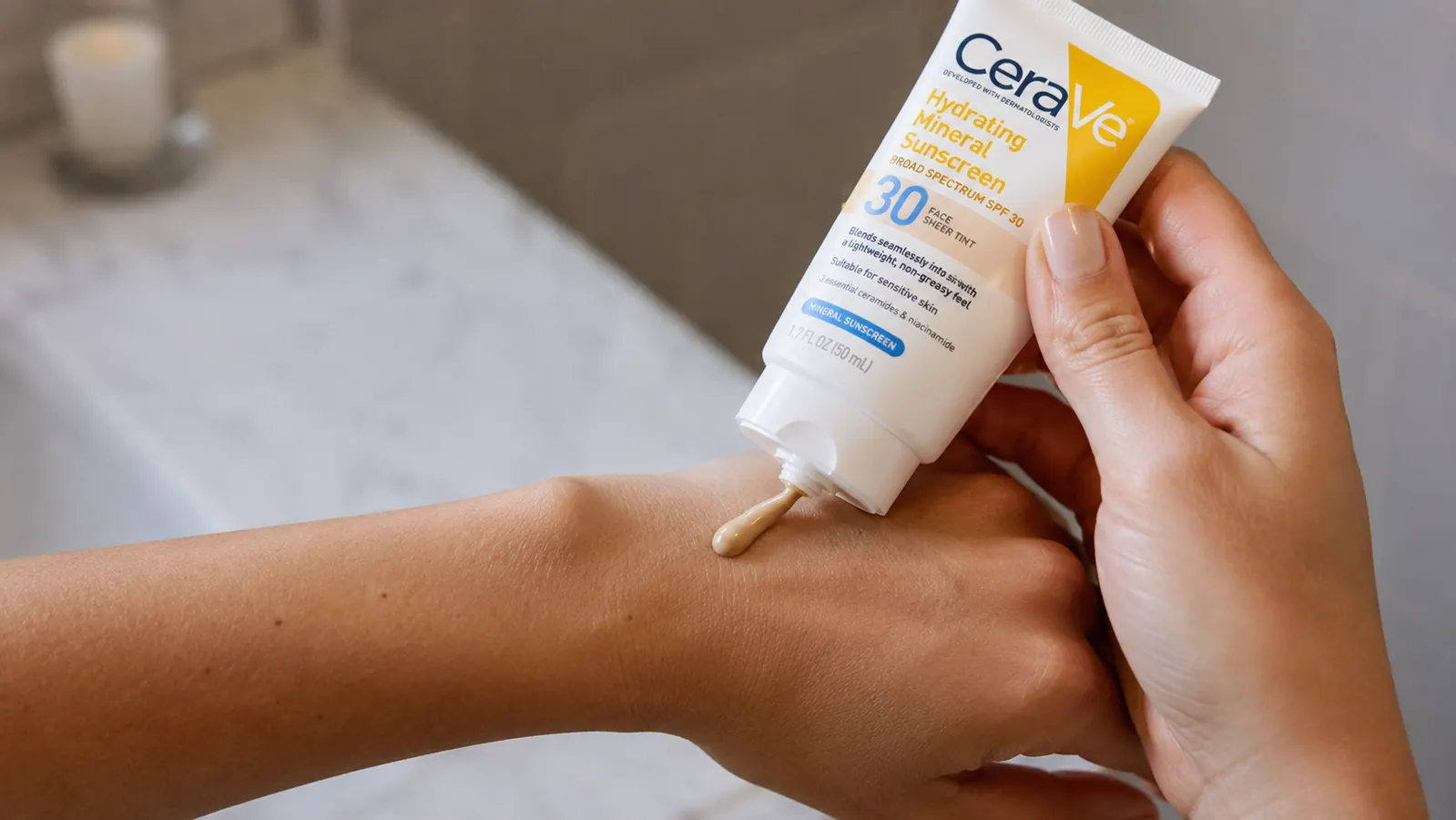
CeraVe Tinted Mineral Sunscreen SPF 30 has over 72,000 Amazon ratings and is formulated with ceramides, niacinamide, and hyaluronic acid. It is the rare sunscreen that also functions as a daily moisturizer and light coverage tint.
Amazon Check Today's Price on Amazon →Where CeraVe Tinted SPF 30 Wins
The first thing I noticed wearing CeraVe Tinted for a week straight: my skin felt genuinely nourished by the end of the day, not just protected. That is because this formula leans hard into skincare actives. Ceramides help repair the skin's moisture barrier. Niacinamide calms redness and tightens the look of pores over time. Hyaluronic acid draws in ambient moisture. You are not just layering a physical UV filter over your skin, you are also feeding it ingredients a morning moisturizer would normally supply. For those of us who are trying to simplify our routines, that is legitimately useful.
The tint itself was better than I expected at this price. On my light-medium complexion, it neutralized the slight chalkiness that pure zinc oxide formulas sometimes leave and added a soft warmth that looked natural in daylight. I did not need concealer on most mornings during the test weeks. The finish landed somewhere between satin and dewy, which I personally like, though anyone with oilier skin might want to set it with a light powder. White cast was visible when I applied too much, so the key is a small amount buffed in with your fingertips, not thick layers.
The price point deserves its own paragraph. At current pricing, you can buy three tubes of CeraVe Tinted for the cost of one La Roche-Posay Anthelios. If you are applying SPF daily (which you should be), the math adds up fast. Over a year of daily use, the savings are significant. That alone makes CeraVe the correct default for most people until they have a specific reason to upgrade.
Where La Roche-Posay Tinted Wins
During the three weeks I wore La Roche-Posay Anthelios Tinted, two things stood out. First, the SPF 50 rating provides a meaningfully higher protection ceiling, especially relevant if you have a history of sunburn, hyperpigmentation triggered by UV exposure, or you are on photosensitizing medications like retinoids or tetracyclines. SPF 30 blocks about 97% of UVB rays. SPF 50 blocks about 98%. That one percent sounds tiny, but the real-world difference over years of daily exposure, particularly for post-acne skin prone to darkening, matters more than the number suggests.
Second, the finish on La Roche-Posay is noticeably more matte and controlled. During my test weeks I had almost zero midday shine, which is not something I can say about CeraVe's slightly dewy formula. If you have oily or combination skin that breaks out under heavier products, the lighter, more mattifying texture of the La Roche-Posay may justify the higher cost. Its tint also blended more convincingly across a slightly broader shade range in my informal side-by-side testing on different forearm patches.
Three weeks in, I kept reaching for CeraVe because my skin felt better at the end of the day, not just protected. The La Roche-Posay wins on SPF and finish, but it does not add anything to the skin the way the CeraVe does.
Formula Deep Dive: What You're Actually Putting on Your Skin
CeraVe Tinted uses zinc oxide as its sole active UV filter. Zinc oxide is a broad-spectrum mineral blocker that sits on top of the skin and scatters both UVA and UVB rays. The supporting cast of ceramides (1, 3, 6-II), niacinamide, and hyaluronic acid is the same lineup found in CeraVe's moisturizing cleansers and creams, so the brand knows what it is doing with this combination. The formula is developed with dermatologists and is suitable for sensitive, eczema-prone, and rosacea-prone skin.
La Roche-Posay Anthelios Tinted uses a combination of titanium dioxide and zinc oxide, which some cosmetic chemists argue gives more complete broad-spectrum coverage than zinc alone. The Mexoryl XL technology the brand uses in its non-US formulas is absent in the American version (FDA regulations limit which UV filters are approved domestically), but the dual-mineral approach still performs well. The formula is lighter in texture and contains fewer heavy film-forming ingredients, which is why it feels less occlusive and more breathable on oily skin.
Coverage and Wearability: Real-World Notes
I wore each formula on a five-mile walk in July, which is an honest stress test. CeraVe held up reasonably well but showed some dewy breakthrough by the two-hour mark. It was not heavy or uncomfortable, just present. La Roche-Posay stayed more controlled through the same walk, looking close to freshly applied at the end. If outdoor activity is part of your daily routine, the La Roche-Posay's longevity and matte finish is a tangible advantage.
For indoor days or commuting, both performed essentially identically. The tint on each reduced the need for separate foundation or BB cream. Under a mask in summer heat, CeraVe transferred more than La Roche-Posay, which is something to consider if you spend time in a mask regularly.

Who Should Buy Which
Pick CeraVe Tinted SPF 30 if: your skin runs dry or normal, you are looking for an SPF that doubles as your morning moisturizer, you have a compromised skin barrier (eczema, rosacea, reactive skin), you are budget-conscious and plan to use SPF every single day, or you are new to mineral sunscreens and want to test the category without a big financial commitment. The 72,000-plus Amazon ratings give you a reliable baseline, and the ceramide-plus-niacinamide formula does real skincare work on top of UV protection.
Pick La Roche-Posay Anthelios Tinted SPF 50 if: you have oily or acne-prone skin that rebels against dewy finishes, you need higher SPF because you are on retinoids or other photosensitizing actives, you have hyperpigmentation from UV damage and want maximum protection, or you are willing to spend more for a finish that holds throughout the day without powder. It is a genuinely good product, just not the right answer for everyone at its price point.
Who Should Skip Both
If you have very dark or deep skin tones, both formulas may still leave a slight ashy cast despite the tint, particularly CeraVe. Neither brand has fully solved the mineral-sunscreen-on-deep-skin problem that synthetic filter formulas handle more easily. In that case, a hybrid mineral-chemical sunscreen or a tinted SPF with a broader shade range would serve you better. Neither product makes a strong case for extremely oily skin that needs clinical-level oil control.
72,000 reviewers can't all be wrong about their daily SPF.
CeraVe Tinted Mineral Sunscreen SPF 30 protects with zinc oxide, repairs with ceramides, and calms with niacinamide, all in one product. It is fragrance-free, derm-developed, and priced so that wearing it every day is realistic.
Amazon Check Today's Price on Amazon →