
I have tested a lot of skincare ingredients over the years, and retinol has the highest drop-out rate of anything I have tried. Not because it does not work. It absolutely does. But because most people start it the same wrong way, get hit with a week of raw, peeling skin around day ten, and then put the bottle under the sink and never touch it again. I was one of those people the first time I tried it at 34. I used it every night from day one, woke up with my cheeks looking like they had been sandpapered, and decided retinol was not for me. I was wrong. The ingredient was fine. My approach was the problem.
The issue is that retinol accelerates skin cell turnover, which is exactly why it reduces fine lines, smooths texture, and fades dark spots over time. But introduce it too quickly and your skin barrier gets overwhelmed before it can adapt. The result is what most people call 'retinization' -- redness, tightness, flaking, and sometimes a temporary breakout that gets misread as a purge. None of that has to happen if you ramp up slowly. Dermatologists have known this for decades. The slow-build method takes about eight to twelve weeks to reach a full nightly routine, but the people who follow it almost always stick with retinol long-term. The people who skip it almost always quit. Here is exactly how I do it now, using CeraVe Retinol Serum as my starting point -- an encapsulated retinol formula that releases the active gradually rather than all at once, which makes the ramp-up even more forgiving.
If you are starting from scratch, this is the serum I'd put in your hands first
CeraVe Retinol Serum uses encapsulated retinol, meaning the active ingredient is housed inside a micro-shell that releases slowly over hours. Paired with niacinamide and three essential ceramides, it was built specifically for people who want retinol results without torching their skin barrier in the process. Rated 4.6 stars across 28,000+ verified Amazon reviews.
Amazon Check Today's Price on Amazon →Step 1: Use the Buffer Method for Your First Two Weeks
The buffer method is simple and highly effective for beginners. Instead of applying retinol serum to bare skin, you apply your regular moisturizer first, wait about two minutes for it to absorb, then put the retinol on top. This dilutes the effective concentration reaching your skin cells and slows penetration just enough to prevent the acute irritation most beginners experience. It does not make the retinol ineffective -- it makes it tolerable while your skin is building tolerance.
During weeks one and two, use the buffer method every single application. Do not skip it even if your skin feels fine. The irritation from retinol often shows up three to five days after the initial application, not immediately, so feeling fine on day two does not mean you can remove the guardrails yet. Once you get through two full weeks with the buffer and no noticeable sensitivity, you can transition to applying retinol directly to clean, dry skin. Some people stay on the buffer method permanently and that is completely valid -- especially if you have sensitive or rosacea-prone skin. With CeraVe Retinol Serum specifically, the encapsulation already provides a built-in slow-release effect, so layering the buffer on top makes the introduction genuinely mild for most skin types.
One timing note: apply retinol on skin that is fully dry, not damp. Wet skin increases absorption significantly, which sounds appealing but is precisely how you trigger irritation as a beginner. Wait at least two minutes after cleansing before any application. Pat dry, wait, then moisturizer, wait, then serum if you are buffering. That brief pause makes a real difference.
Step 2: Start at Once Per Week and Ramp Frequency Slowly
This is the step most people skip because it feels too slow. They reason that if one night a week is good, three nights is better, and every night is best. But your skin's barrier function needs time to upregulate its natural defense mechanisms in response to retinol. That adaptation happens over weeks, not days. Jumping ahead on frequency is the number one cause of the dreaded week-two blowup where everything suddenly goes red and tight.
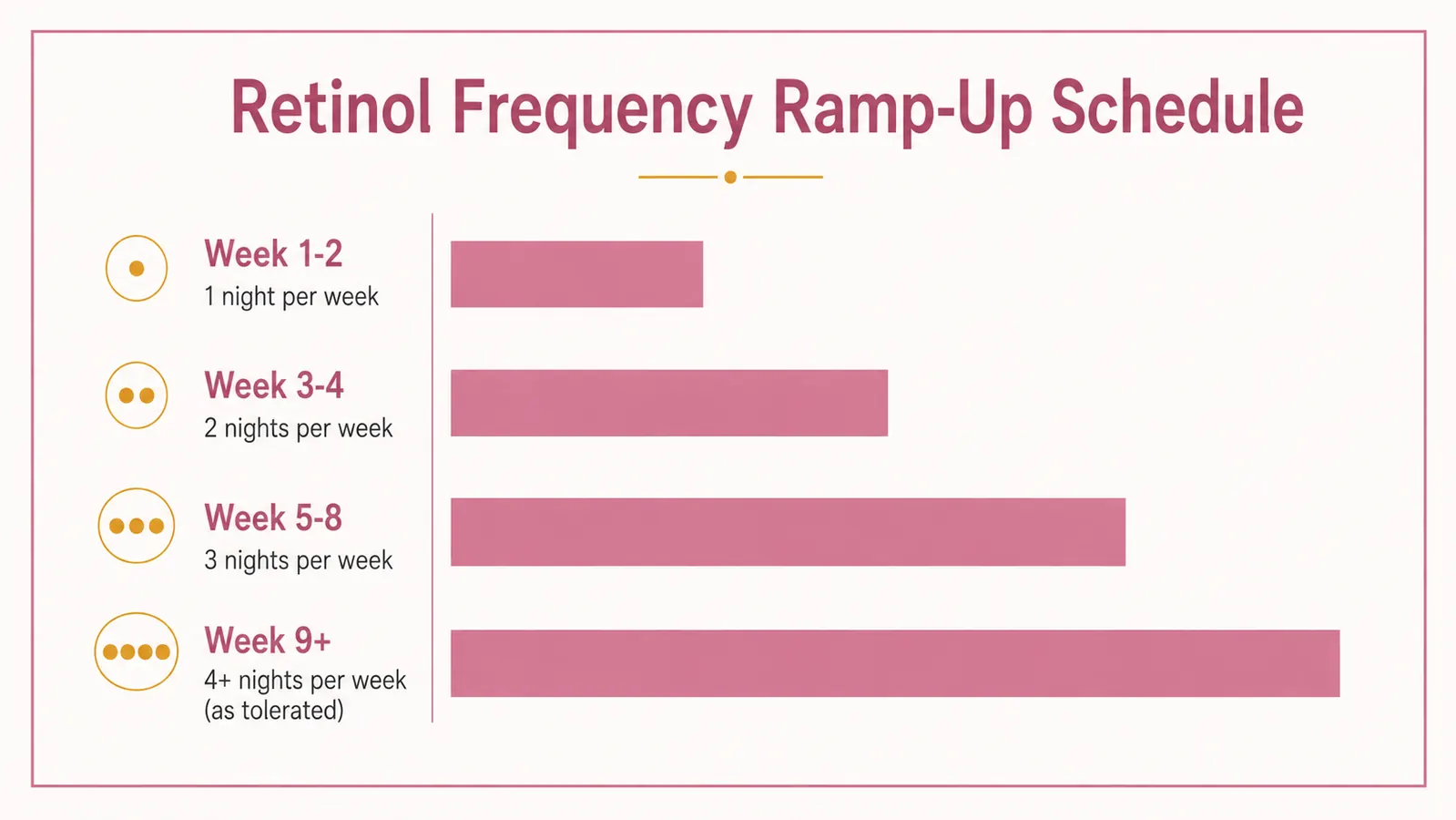
My recommended schedule looks like this: once per week for weeks one and two, twice per week for weeks three and four, every other night for weeks five through eight, then nightly from week nine onward if your skin tolerates it well. That is a nine-week ramp. It feels unnecessarily cautious until you talk to anyone who tried to do it in two weeks and spent a month managing a damaged skin barrier. The ramp is the method. Deviating from it is the most common reason people fail with retinol.
If at any point you notice significant redness, peeling that goes beyond light flaking, or noticeable tightness that does not resolve overnight, go back one step in the frequency schedule and hold there for another two weeks before trying to advance again. That is not failure. That is exactly how the process is supposed to work. Retinol is a long game measured in months, and the results at month six or month twelve look dramatically different from week three regardless of how fast you ramped.
Step 3: Lock In the Moisturizer Sandwich Technique
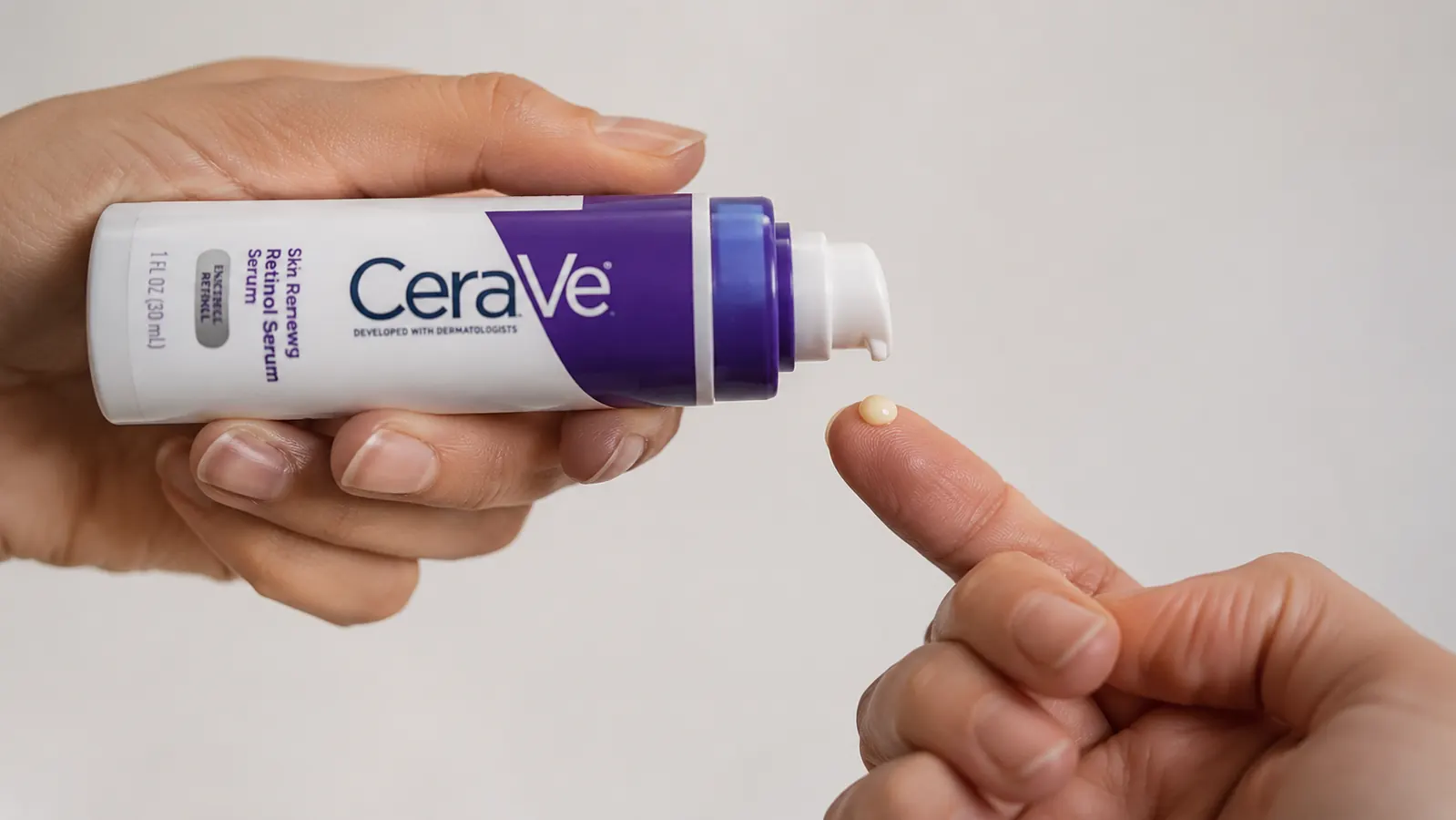
Once you move off the buffer method and start applying retinol directly to skin, you need a new protection strategy: the moisturizer sandwich. This means applying a thin layer of moisturizer before the retinol (the bottom slice of bread), applying the retinol, and then applying another layer of moisturizer on top (the top slice of bread). The bottom layer creates a small amount of dilution and slows penetration. The top layer seals everything in and keeps your barrier from losing moisture overnight while the retinol does its work.
For the moisturizer layers, use something simple and barrier-focused. Fragrance-free formulas with ceramides or hyaluronic acid work well here. You want to support the barrier, not add more actives on top of an active. On the nights I use CeraVe Retinol Serum, I reach for a plain ceramide moisturizer on both layers -- nothing with exfoliating acids, vitamin C, or other actives that could compound irritation. Keeping those actives on separate nights, especially in the early months, is smart skincare management rather than excessive caution.
The sandwich is not a permanent technique. Most people phase it out around months three to four as their skin builds tolerance and the barrier becomes more resilient. But in the first twelve weeks it is genuinely useful, and using it costs you nothing except an extra thirty seconds in your routine.
Step 4: Keep It Nighttime Only and Pair Every Morning With SPF

Retinol is photosensitive, meaning UV exposure degrades it and makes it far less effective. Beyond that, retinol temporarily increases your skin's sensitivity to the sun, raising your burn risk in the short term. For both reasons, retinol belongs exclusively in your nighttime routine. Morning retinol application is not a grey area -- it is simply the wrong time. The darkness of your skin's overnight repair cycle is when retinol is doing its highest-quality work anyway.
The non-negotiable partner for any retinol routine is SPF applied every single morning. Not because of some loose recommendation, but because new skin cells generated by retinol's accelerated turnover are more vulnerable to UV damage than older, more keratinized cells. Skipping sunscreen while using retinol is actively counterproductive. You are generating fresh skin faster and then handing it over to UV damage without protection. SPF 30 or higher every morning, regardless of cloud cover, is the one skincare rule I will not bend on when retinol is in the routine. Apply it as the last step of your morning routine, after any serum or moisturizer.
Step 5: Know When to Push Forward and When to Hold Back
After eight to twelve weeks of diligent slow-build, most people are applying retinol every other night or every night with minimal reaction. At that point the question becomes whether to push to a higher concentration, add more frequency, or simply maintain what is working. My honest answer: if what you are doing is giving you visible results in texture or fine lines, there is no urgency to push. More retinol is not automatically better retinol. The dose that your skin tolerates without irritation and that produces sustained, consistent turnover is the right dose for you, full stop.
That said, there are signs that you are ready to advance. If you have been on a specific frequency for eight weeks with zero irritation, your skin may be ready for more. If you have been using a low-concentration formula like CeraVe Retinol Serum for four to six months with excellent tolerance, you might try a slightly higher concentration and restart a gentler version of the ramp. Never jump more than one step at a time. Any new concentration should be treated as a fresh start, not a continuation of your existing tolerance. For most people between 35 and 55, maintaining a consistent retinol routine with a gentle, well-formulated serum over years produces better skin outcomes than chasing high concentrations that force repeated barrier disruption and recovery cycles.
One concrete signal that you have pushed too far: if you notice that your skin looks more irritated or dull rather than clearer and smoother, pull back on frequency for a week and rebuild. Retinol results are not linear on a week-to-week basis. There will be weeks where your skin looks worse, often correlated with stress, season changes, or hormonal shifts. Those weeks are not the time to push. They are the time to hold and let the barrier recover.
What Else Helps
Beyond the five-step method itself, a few supporting habits make a meaningful difference in how well retinol works and how comfortable the process feels. First, stay consistent with cleansing. A gentle, non-stripping cleanser before retinol keeps your skin clean without compromising the barrier before you introduce the active. Foaming cleansers with sulfates are the wrong choice here. A creamy or gel cleanser with a pH close to skin's natural 4.5 to 5.5 is a better fit for a retinol night.
Second, keep retinol on separate nights from other actives, at least for the first three months. Vitamin C is a morning ingredient anyway, so that is easy to manage. Exfoliating acids (AHAs and BHAs) are the ones most commonly layered incorrectly. Using a glycolic or salicylic acid on the same night as retinol, even in separate steps, significantly compounds irritation risk in the early months. Alternate nights or separate by morning versus evening use. Once your barrier is well-adapted to retinol around month four or five, you can experiment with adding actives back carefully, one at a time, watching for cumulative irritation.
Third, if you have a particularly sensitive skin week, due to illness, stress, a change in season, or hormonal shifts, it is completely fine to skip retinol for a few nights and prioritize moisturizer and gentle barrier care. Missing a few applications does not set you back meaningfully. Your skin's retinol tolerance is not like a gym streak where missing one day resets the clock. Once your skin has adapted, the baseline tolerance stays. Rest when it makes sense and pick up again when your skin is stable. The people who stick with retinol for years tend to be the ones who treat it flexibly rather than rigidly.
If you want a deeper look at CeraVe Retinol Serum specifically, including how it performed over three months of nightly use, the long-term review covers ingredient analysis, week-by-week observations, and who it is genuinely right for. And if you want to understand why retinol is consistently ranked as one of the most evidence-backed anti-aging ingredients in dermatology, the guide on retinol serum reducing wrinkles walks through the science in plain language.
The people who quit retinol in week two almost always quit for the same reason: they went from zero to every night in a few days. The people who stick with it for years almost always did the slow build. There is no shortcut worth taking here.
Ready to start? CeraVe Retinol Serum is the easiest beginner entry point I have found
CeraVe's encapsulated retinol formula releases the active slowly, cutting down irritation for first-timers without sacrificing long-term results. It includes niacinamide to calm inflammation and ceramides to actively support your barrier while retinol does its turnover work. Over 28,000 Amazon reviews, rated 4.6 stars. This is where I would tell anyone to start.
Amazon Check Today's Price on Amazon →